
Showing posts with label Louis Moore. Show all posts
Showing posts with label Louis Moore. Show all posts
2.05.2010
Hannibal Author Posts Blog About Southern Baptists in Haiti
In a post on his blog, Louis Moore on Religion, Hannibal author Louis Moore proposed that Southern Baptist Convention leaders should step forward and take responsibility for preaching the message to 'go'. This is in connection to the 10 Southern Baptists who are in legal trouble in Haiti after they went to the country without training or legal preparation and now face charges for trying to cross the border with children who had no documentation.
In his post, Louis--who was the religion editor for the Houston Chronicle for nearly 15 years--says this kind of legal incident is by no means rare and that SBC leaders should accept responsibility for their fervent insistence that church members 'go' to share the gospel, but who don't always provide the proper training for these 'independent' missions.
To read Louis' post, visit his blog at louismooreonreligion.blogspot.com or click here.


5.29.2009
How Do Working Parents Juggle Church Activities?
 In homes throughout the United States, both husbands and wives hold outside jobs. This includes Christians as well as non-Christian families. How do these families manage to balance their work, home, and church responsibilities? How do they continue to include the church in their hectic schedules? How do church leaders minister to the stresses involved in two-paycheck families? How can they best utilize these church members who constantly are short on time?
Journalists Louis and Kay Moore interviewed numerous other Christian, two-paycheck couples to see how these were coping with such conflicts. In this book, When You Both Go to Work: How Two-Paycheck Families Can Stay Active in the Church the Moores share what they have learned from these couples and from their own experiences about setting priorities, budgeting time, learning when to say no (and when to say yes), and dealing lovingly with criticism.
When You Both Go to Work answers questions such as:
* What does the Bible say about women working outside the home?
* Does being a two-paycheck family go against God's plan for men and women?
* How can I decided which church activities to attend and which to give up when my time is limited?
* How do I deal with disagreements with fellow Christians about this important issue?
* How can I as a church leader make my programs more responsive to the needs of two-paycheck families?
* How can I plan wisely so that heavy demands on my time don't endanger my spiritual life?
2.23.2009
2009 Mark Twain School a Success
The 2009 Mark Twain School has officially come and gone! Whew - what a whirlwind weekend! We at Hannibal Books hope the participants learned a lot and enjoyed getting to know our staff! We most certainly enjoyed speaking with the current authors and the potential authors. Many great ideas were shared!


Left: One of Hannibal Books' displays.


Left: Participants mingle during a break on Saturday. The CrossHouse (the self-publishing arm of Hannibal) display is in the background.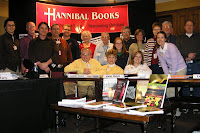

Left: All of the 2009 Mark Twain School participants, as well the staff of Hannibal & CrossHouse.


Left and right: 2009 Mark Twain participants discuss some of the nuts and bolts of writing and publishing a book.
In upcoming blogs, we'd like to share some of the information that we discussed at the Mark Twain School. For now, listed below are a few topics that were covered.
* History of Hannibal Books and CrossHouse Publishing and our niche in the market
*Overview of Christian publishing
*Learning the publishing lingo
*10 things to know when you get published
*The process of choosing a topic and beginning to work with a publisher
*Getting the word out - publicity
*Graphics that sizzle
*How to write right
*The business of writing
Watch this blog and www.HannibalBooks.com for information about next year's conference, usually held in February. Below are a few photos from this conference.

Left: One of Hannibal Books' displays.
Right: Kay Moore discusses writing right with the 2009 Mark Twain participants.


Left: Participants mingle during a break on Saturday. The CrossHouse (the self-publishing arm of Hannibal) display is in the background.
Right: Most of the participants and the staff of Hannibal & CrossHouse.


Left: All of the 2009 Mark Twain School participants, as well the staff of Hannibal & CrossHouse.
Right: Louis Moore reads from his book, Witness to the Truth, during the evening session.


Left and right: 2009 Mark Twain participants discuss some of the nuts and bolts of writing and publishing a book.
.JPG)

1.26.2009
Reflections on two presidential inaugurations 40 years apart
The following is a blog by Louis Moore, co-owner of Hannibal Books and author of Witness to the Truth. Louis and his wife, Kay, traveled to Waco, TX, to visit the Baylor University campus (where they both attended college) and to speak with various classes about their experiences as journalists. This blog is from Louis Moore's personal blog, Louis Moore on Religion, about his time in Waco.
Forty years ago, on January 20, I was serving as editor of The Baylor Lariat, the student newspaper at Baylor University in Waco, TX, and busy supervising the newspaper's coverage of the inauguration of Richard Nixon to succeed Lyndon B. Johnson as President of the United States.
Our student newspaper desks contained the old Royal typewriters. Stories were typed on paper, then edited by hand before being transported across campus to the Baylor Press, where they were keypunched into an old linotype machine complete with hot, molten metal. We watched the Nixon inauguration on a 13-inch, black-and-white TV carted into The Lariat newsroom for inauguration day. We obtained our Associated Press wire stories about the event from an old AP machine that noisily flowed a steady stream of paper from its top. (Right: Louis Moore with an old AP machine.)
This past Tuesday, January 20, I thought back to those days while I visited The Baylor Lariat offices, one of my few times since 1969 to be there. I just marveled at how things had changed and yet how they had remained so much the same. Student reporters this week sat in front of beautiful, clean iMac screens. They watched the news on a large, overhead color TV that appeared to be a permanent fixture in The Lariat newsroom. Their news of the inauguration of Barack Obama arrived via emails and blogs written by four Lariat students in D.C. for the event. Student reporters in my day would have been blown away by the possibility of The Lariat paying their way to Washington for the inauguration.
Watching President Obama's inauguration also stirred memories of four decades earlier. I entered Baylor the same semester John Westbrook broke the racial barrier, moved into Baylor's Martin Hall, and joined the Baylor Bears on the football field. As The Lariat editor in 1968-69, I hired the first African-American reporter for the school's newspaper. His name was Willie White. I worked diligently to see that he was in line to become editor of The Lariat two years later. I also wrote an editorial in The Lariat welcoming Dr. Vivienne Mayes as the first Baylor professor of African-American heritage to the campus. My editorial scolded the Baylor administration for waiting so long to hire a black professor and also for trying to play down the fact that Dr. Mayes had been denied admission as a student some years earlier because of her race.
So here I was 40 years to the day later sitting in The Lariat newsroom watching on TV as America inaugurated its first President of African-American heritage. The goose bumps told me that was actually more overwhelming than was seeing the computers sitting on the students' desks. (Later that day I was also on Interstate 35 after former President George Bush landed in Waco and his motorcade traveled on to Crawford.)
I was there as a guest of the Journalism Department to talk about my career in religion journalism and my new book, Witness to the Truth. I spent two days lecturing in classes, chatting with students, and visiting with professors in both the journalism and religion departments. What a marvelous and humbling experience it was! I must admit I felt a bit ancient looking into the faces of the young student journalists—and even into the faces of many of the journalism professors. I was grateful that my host, longtime friend from college days and now Baylor journalism professor Mike Blackman, accompanied me most of the time I faced the youngsters.
 I also thanked God that most of the religion professors with whom I dined were around my vintage. Lariat reporter Jenna Williamson (left, in an interview with Mr. Moore) did an excellent job in her interview and article about Kay and me being back in The Lariat newsroom for the inauguration coverage. Students seemed bright-eyed and eager to learn. I particularly enjoyed giving lectures on ethics in the media. Some of my greatest delights arrived afterward when Jenna, Mike, and others wrote to say students were still discussing what I had to say about ethics in the field of journalism. I had been able to tell by their eyes, rapt attention, and questions that they were listening without diversion.
As Kay and I bid adieu to the faculty and students Wednesday afternoon, I felt really good about the future of newspaper reporting in the next generation. Baylor journalism grads have always been a magnificent lot. I'm now confident that tradition will carry forth into future years.

 From right to left, religion professor Jeter Basden, journalism professor Mike Blackman, religion department chair and professor Bill Bellinger, religion professor Brian Harbour, religion Dennis Horton, journalism professor Brad Owen, with Baylor journalism graduates and authors Louis and Kay Moore.
Forty years ago, on January 20, I was serving as editor of The Baylor Lariat, the student newspaper at Baylor University in Waco, TX, and busy supervising the newspaper's coverage of the inauguration of Richard Nixon to succeed Lyndon B. Johnson as President of the United States.
Our student newspaper desks contained the old Royal typewriters. Stories were typed
 on paper, then edited by hand before being transported across campus to the Baylor Press, where they were keypunched into an old linotype machine complete with hot, molten metal. We watched the Nixon inauguration on a 13-inch, black-and-white TV carted into The Lariat newsroom for inauguration day. We obtained our Associated Press wire stories about the event from an old AP machine that noisily flowed a steady stream of paper from its top. (Right: Louis Moore with an old AP machine.)
This past Tuesday, January 20, I thought back to those days while I visited The Baylor Lariat offices, one of my few times since 1969 to be there. I just marveled at how things had changed and yet how they had remained so much the same. Student reporters this week sat in front of beautiful, clean iMac screens. They watched the news on a large, overhead color TV that appeared to be a permanent fixture in The Lariat newsroom. Their news of the inauguration of Barack Obama arrived via emails and blogs written by four Lariat students in D.C. for the event. Student reporters in my day would have been blown away by the possibility of The Lariat paying their way to Washington for the inauguration.
Watching President Obama's inauguration also stirred memories of four decades earlier. I entered Baylor the same semester John Westbrook broke the racial barrier, moved into Baylor's Martin Hall, and joined the Baylor Bears on the football field. As The Lariat editor in 1968-69, I hired the first African-American reporter for the school's newspaper. His name was Willie White. I worked diligently to see that he was in line to become editor of The Lariat two years later. I also wrote an editorial in The Lariat welcoming Dr. Vivienne Mayes as the first Baylor professor of African-American heritage to the campus. My editorial scolded the Baylor administration for waiting so long to hire a black professor and also for trying to play down the fact that Dr. Mayes had been denied admission as a student some years earlier because of her race.
So here I was 40 years to the day later sitting in The Lariat newsroom watching on TV as America inaugurated its first President of African-American heritage. The goose bumps told me that was actually more overwhelming than was seeing the computers sitting on the students' desks. (Later that day I was also on Interstate 35 after former President George Bush landed in Waco and his motorcade traveled on to Crawford.)
I was there as a guest of the Journalism Department to talk about my career in religion journalism and my new book, Witness to the Truth. I spent two days lecturing in classes, chatting with students, and visiting with professors in both the journalism and religion departments. What a marvelous and humbling experience it was! I must admit I felt a bit ancient looking into the faces of the young student journalists—and even into the faces of many of the journalism professors. I was grateful that my host, longtime friend from college days and now Baylor journalism professor Mike Blackman, accompanied me most of the time I faced the youngsters.
 I also thanked God that most of the religion professors with whom I dined were around my vintage. Lariat reporter Jenna Williamson (left, in an interview with Mr. Moore) did an excellent job in her interview and article about Kay and me being back in The Lariat newsroom for the inauguration coverage. Students seemed bright-eyed and eager to learn. I particularly enjoyed giving lectures on ethics in the media. Some of my greatest delights arrived afterward when Jenna, Mike, and others wrote to say students were still discussing what I had to say about ethics in the field of journalism. I had been able to tell by their eyes, rapt attention, and questions that they were listening without diversion.
As Kay and I bid adieu to the faculty and students Wednesday afternoon, I felt really good about the future of newspaper reporting in the next generation. Baylor journalism grads have always been a magnificent lot. I'm now confident that tradition will carry forth into future years.

From left to right, Baylor University journalism professor Mike Blackman, Baylor retired religion chair and professor Glenn Hilburn, Baylor graduate and author Kay Moore, and Baylor graduate and author Louis Moore at a luncheon for Louis and Kay sponsored by the Baylor journalism department.
 From right to left, religion professor Jeter Basden, journalism professor Mike Blackman, religion department chair and professor Bill Bellinger, religion professor Brian Harbour, religion Dennis Horton, journalism professor Brad Owen, with Baylor journalism graduates and authors Louis and Kay Moore.
1.19.2009
Pastor Steve Weaver's "Books Read in 2008"
Pastor Steve Weaver lists "Books Read in 2008" on his blog. He kindly mentions Hannibal author Louis Moore and his book Witness to the Truth: Lessons learned by a veteran journalist through four decades of watching the church. Pastor Weaver says he sets a goal each year of reading 52 books. What a great idea!
Louis Moor e, (pictured below) co-owner of Hannibal Books, was the religion editor at the Houston Chronicle for almost 15 years, was the editor at the Plano Star Courier and has worked within the
  Southern Baptist Convention as a media executive. He graduated from Baylor University where he was editor of The Lariat, the student newspaper.
 e, (pictured below) co-owner of Hannibal Books, was the religion editor at the Houston Chronicle for almost 15 years, was the editor at the Plano Star Courier and has worked within the
  Southern Baptist Convention as a media executive. He graduated from Baylor University where he was editor of The Lariat, the student newspaper.
Moore's book, Witness to the Truth, identifies 26 core “truths” that apply to a variety of religious groups regardless of their persuasion. His parallels are designed to help readers better understand their own local church bodies and their roles in them.
Subscribe to:
Comments (Atom)